
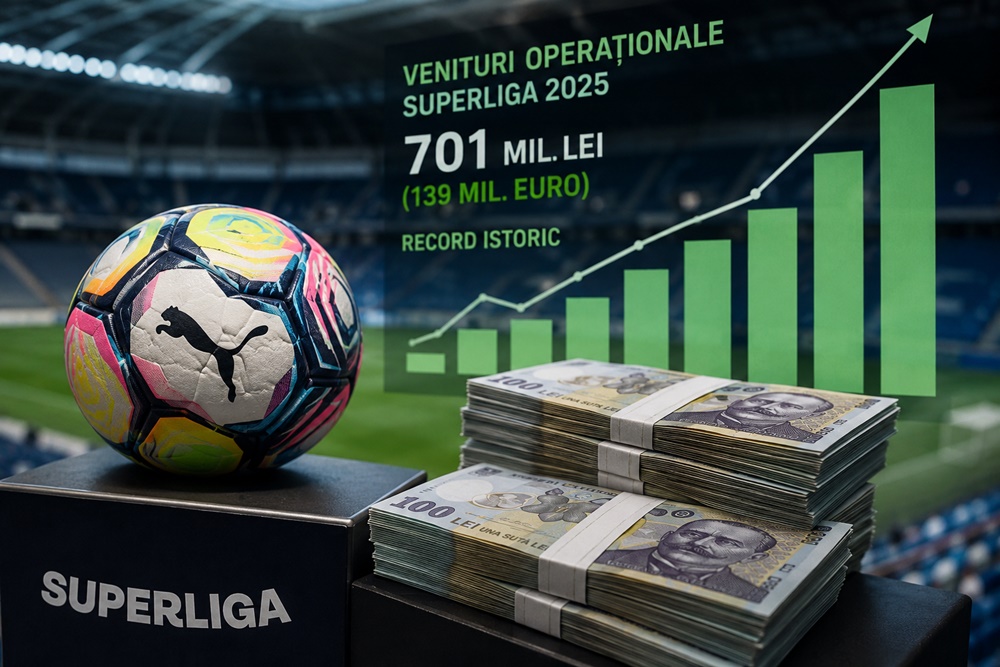
SuperLiga clubs recorded their highest revenues in recent years. According to a report published by the Romanian Football Federation (FRF), the league’s 16 clubs generated operational revenues of 701 million RON (€139 million) in 2025, up by 130 million RON (€26 million) compared to the previous year.
The figures presented by FRF show growth across the entire competition and confirm the increasing importance of European competitions for club budgets.
European Competitions Have Become a Key Source of Revenue
Revenue generated from UEFA competitions increased by 68 million RON (€13.5 million) compared to 2024 and reached its highest level in recent years.
Money received from UEFA now accounts for 18% of clubs’ total revenues, matching the share generated by television rights.
Sponsorship and advertising remain the largest source of income, representing 25% of total revenues.
Clubs Managed Their Spending More Carefully
The FRF report shows that SuperLiga clubs managed their budgets more efficiently in 2025.
The clubs posted combined losses of 121 million RON (€24 million), which is 30 million RON (€6 million) less than in the previous year.
In addition, wages accounted for 73% of club revenues, down from 79% in 2024.
In other words, expenses increased at a slower pace than revenues.
Record Investments in Youth Academies
In 2025, SuperLiga clubs invested a total of 84.7 million RON (€16.8 million) in youth academies, an increase of 29% compared to the previous year.
The average investment reached 5.29 million RON (€1.05 million) per club, exceeding the €1 million mark for the first time.
Universitatea Craiova, FCSB, Rapid, Csikszereda and Farul were the clubs that invested the most in youth development.
Six Clubs Finished the Year in Profit
Despite lower transfer income compared to previous seasons, six clubs ended the 2025 financial year with a net profit.
Universitatea Craiova, Universitatea Cluj, FCSB, FC Botoșani, Csikszereda and Oțelul Galați all reported positive financial results.
Net transfer revenues amounted to just 4 million RON (€0.8 million) across the entire league, below the levels recorded in previous years.
SuperLiga Has Grown Strongly Since the Pandemic
Compared to 2019, the last full year before the COVID-19 pandemic, total revenues generated by SuperLiga clubs increased by 106%.
During the same period, between 2019 and 2025, expenses rose by 93%.
The difference suggests that revenues have grown faster than costs, one of the indicators of a healthier financial environment.
The FRF report paints the picture of a league that generates more money than it did a few years ago, invests more heavily in youth development and relies increasingly on performances achieved in European competitions.





Be First to Comment