
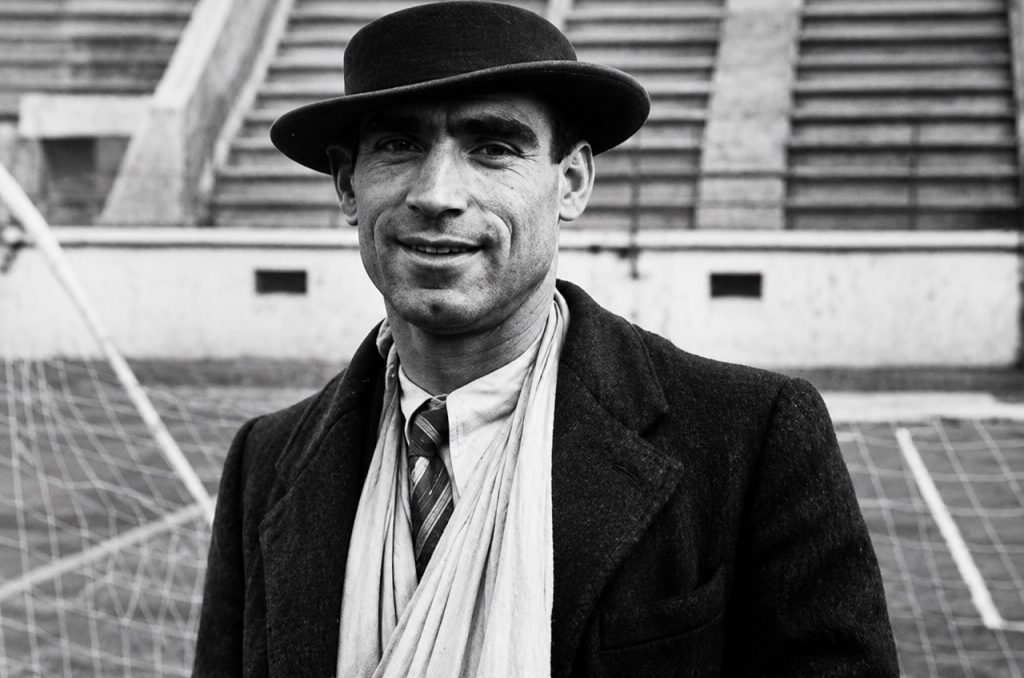
Grottarossa, on the outskirts of Rome. March 30, 1930.
Ezio Sclavi is facing Eugenio Danese, a sports journalist and an experienced fencer. The Lazio goalkeeper has one major disadvantage: until a few days earlier, he had barely held a sword.
 It had all started with a newspaper article. Sclavi had been called up to the Italian national team, a decision that had not been welcomed by part of the Roman press. Convinced that Danese had written one of the articles criticising him, Sclavi met him one evening in Piazza Colonna and slapped him.
In Italy at the time, disputes like this could also be settled outside a courtroom. Danese challenged him to a duel.
The confrontation at Grottarossa did not last long. Danese attacked, suffered a minor scratch and the witnesses stopped the duel. Sclavi, despite having almost no experience with a sword, was declared the winner.
Later, he found out the most ironic detail of the whole episode: Danese had not even written the article.
The two later became friends.
Paris, December 1933
At Galerie Jacques Bonjean, works by Corrado Cagli, Giuseppe Capogrossi and Emanuele Cavalli are being exhibited alongside those of another Italian who spends his weekends in a much noisier place than an art gallery.
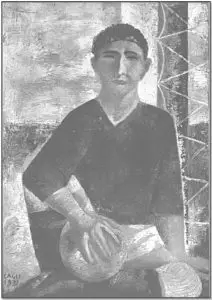 His name is Ezio Sclavi and he is Lazio’s goalkeeper.
Painting was not just a hobby for him. Sclavi was part of Rome’s artistic circles and had become close to Corrado Cagli, one of the important artists of the period. Cagli had painted him as early as 1931 in a work simply titled Portiere — Goalkeeper.
Two years later, Sclavi was exhibiting in Paris alongside Cagli, Capogrossi and Cavalli. In the exhibition catalogue, critic Waldemar George grouped them under the name École de Rome, a label that would become associated with one of the most important generations of Italian interwar art.
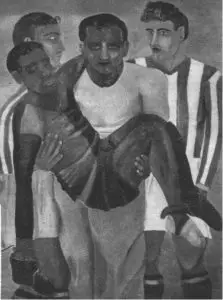
Football also appeared in Sclavi’s paintings. In I compagni — The Teammates — he shows his teammates in a dressing room before a match, while in Il calciatore ferito — The Injured Footballer — an injured player is surrounded by the others.
In 1934, while he was still an important name in Italian football, Sclavi also had work at the 19th Venice Biennale.
A Lazio goalkeeper at the Biennale, not as a guest, but as an artist.
Padova, 1934
A long-range shot goes into the net and Ezio Sclavi does not react. He had not seen the ball.
 A short time earlier, he had taken a heavy blow to the head. The doctor diagnosed concussion, but the Lazio goalkeeper insisted on continuing. He stayed in goal, finished the match and, after the final whistle, could remember almost nothing of what had happened on the pitch.
Sclavi was very different from the modern goalkeeper. He was under 1.70 metres tall, with a powerful upper body and unusually long arms, which earned him the nickname La scimmia — “The Monkey”. He made up for his lack of height with his jumping ability, strength and an aggressive, spectacular style. He had also reached the Italian national team.
And, in a way, it had all started because he wanted to spend less time in the barracks.
While doing his military service in Rome, Sclavi noticed that soldiers who played football were more likely to be granted leave. He started looking for a team and, after a few attempts, ended up at Lazio.
What was supposed to give him a few extra hours of freedom turned into more than a decade in the Biancocelesti goal.
Tabora, 1942
Thousands of kilometres from Rome, inside a British camp in Tanganyika, Ezio Sclavi is painting again.
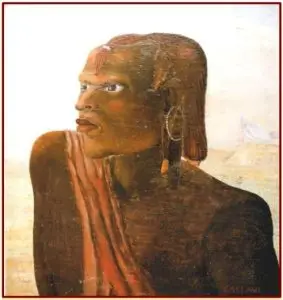 He no longer has his studio or the group of artists he knew in Rome, so he uses whatever materials he can find and continues to work. Among the paintings from that period is a portrait of a young African man.
How had the Lazio goalkeeper ended up there?
In 1935, Sclavi had volunteered for the war in Ethiopia and joined a motorcycle unit. When the conflict ended, he did not return home. He settled in Addis Ababa and, in 1937, opened a transport company.
Football was still part of his life. He organised and coached a team from the Italian community, O.P.R.A.R.E., which won the local championship three times. He sometimes played as well, but no longer in goal. He played as a striker.
The Second World War then reached East Africa and, in 1941, the British captured Sclavi and interned him at Tabora, where he would remain a prisoner for almost six years.
Even there, Sclavi continued to paint and play football. The man who had exhibited in Paris and Venice was now producing paintings with improvised materials inside a camp in Africa. He was physically strong, but by nature quiet and often sombre.
He was released only in 1947. When he returned to Italy, he was 44, almost penniless and unsure how to start again. He went to live with his sister in Liguria, while football was left behind for good.
Sclavi returned to painting, something he had continued to do in Rome, in Africa and even during his years in captivity.




Be First to Comment